![IMG_5906[1]](https://tcuvisualculture.wordpress.com/wp-content/uploads/2016/04/img_59061.png)
As I was scrolling through my camera roll, looking for ideas for the blog, I scrolled past this time frame and noticed how many videos of music festivals I had taken, many the short length of a saved Snapchat video. Most people are guilty of it, but usually I tend to get annoyed when everyone around me at a show is just taking videos and pictures instead of watching the show and enjoying the experience for themselves. I usually try to follow my own advice and do that, but this little stretch of my camera roll proved that maybe that isn’t so true. It looks like I am just as guilty as everyone else I’ve judged. I realized that this world of social media and the desire to share evidence of every experience online is such a driving force in our culture, that we have become part of it, even if we are reluctant to admit it. If anything, at least I am now more aware of my place in the social media world and understand a little more about how I actually act in that culture.
Nick Guidry

 Every day, the average person checks their phone about 110 times per day if not more. With the release of the first iPhone in 2007, I’m sure that people were not as consumed with their phones as they are today. Before the iPhone, an average phone could be used to send text messages, make phone calls, and maybe, just maybe, check your email if you wanted to pay for that cost of surfing the web. In today’s world, the iPhone is used for so much more. There are all sorts of apps and tech specs on the iPhone that set it so far apart from the 1st generation iPhone. The problem is, the iPhone has captivated its users so much that it has prevented them from really observing the world around them. No longer do you see the blue sky for what it is but rather what you can make of it using the iPhone filters. Nothing is as simple as it could be or used to be. I have had a few friends who have given up all apps on their phone except for the necessity text and phone call. I wish I could go into more depth about the difference it made, but that would take too long of a blogpost. Do you think the creators of the iPhone intended for users to become so consumed with their phones that they don’t even notice what’s around them? People often use their phones as a way to avoid having to acknowledge or talk to someone, which I think is flat out ridiculous, but it still happens. I have even been guilty of this myself. Do you think that this could be detrimental to society and perhaps even our brains as we are becoming more and more reliant on technology and specifically the iPhone?
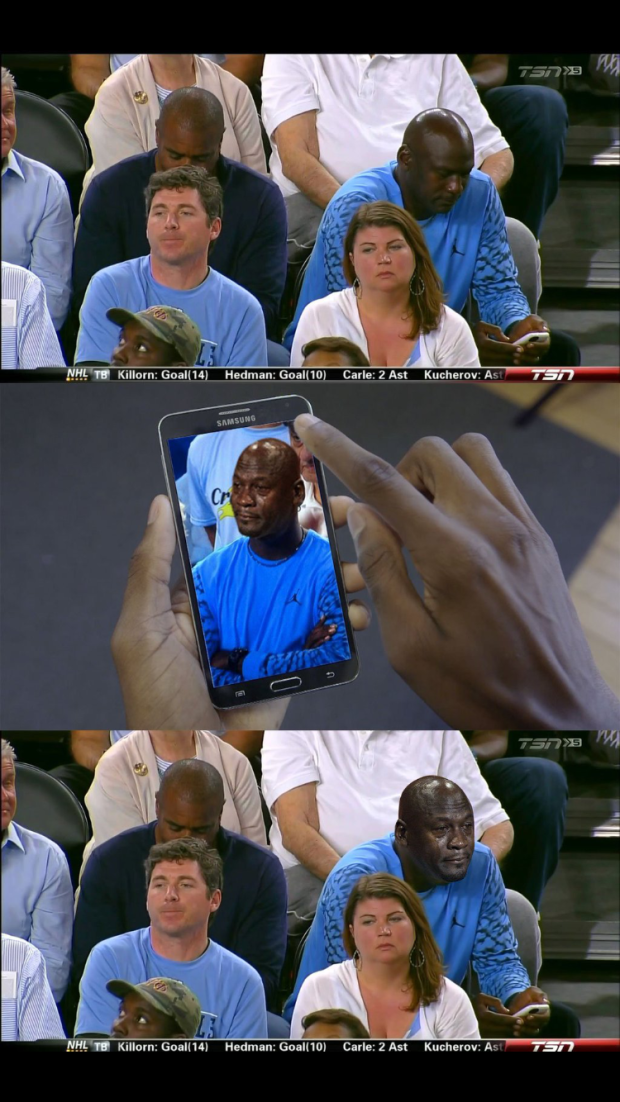 With the NCAA Championship have come and gone, the UNC Tarheel’s hopes of another National Championship was vanquished by Villanova’s 3-point buzzer beater. Michael Jordan was in attendance as he attended UNC and, unfortunately, he became subject to a meme. Of himself. From a different time. There is a very popular meme called Crying Jordan that is used to represent someone who is upset or just totally taken by surprise over an unfortunate circumstance. This 3-point buzzer beater defines an unfortunate circumstance, and within minutes of the finale this picture was featured on my Twitter feed and also featured on Bleacher Report as well as ESPN the following morning. This is only one of several Jordan memes that were created due to this game. The use of this Crying Jordan meme shows just how popular the meme culture has become. This picture not only gaining 5,000 retweets and 10,000 favorites overnight on Twitter, but was also featured on the biggest sports station in the world. I found this meme to be hilarious, especially as this meme of Michael Jordan was placed on Michael Jordan himself, creating a sort of Meme-ception.
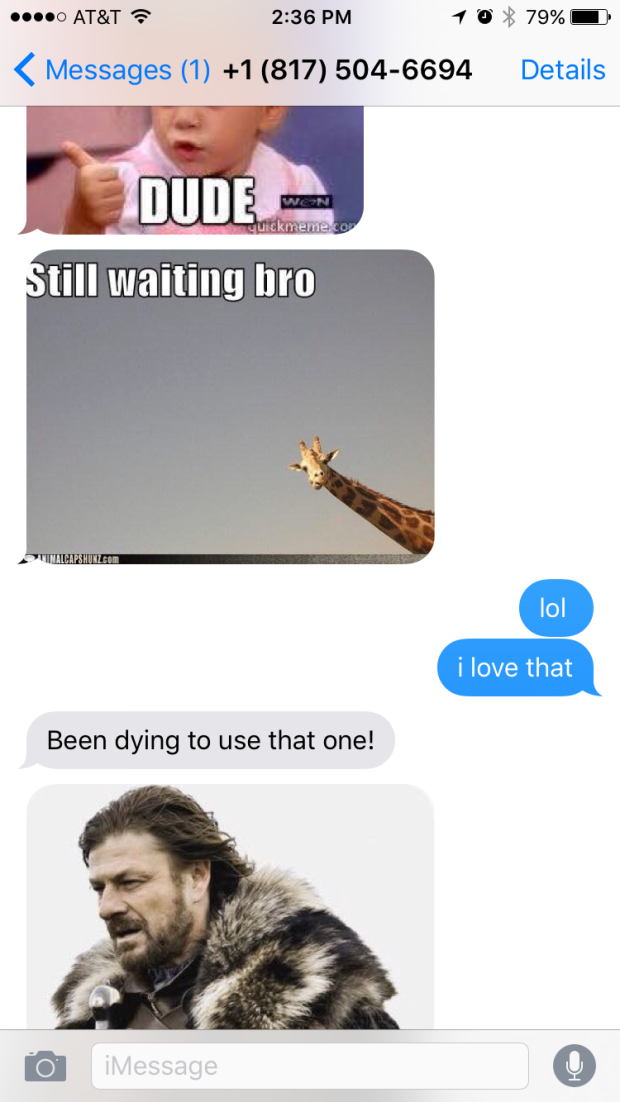 When I think of memes, I think of internet culture and websites like Tumblr and Reddit. But, recently memes have been moving into the mainstream. I received this series of texts from my Favor driver the other day when she was running a favor for me. Instead of using actual words to let me know that my food was taking a while, she chose to send a meme. I was amused to say the least. To make things even better, she chose to send me a meme of Ned Stark with the caption “Favor is coming” to let me know she had my food and was on the way. Little did she know that my friend who was splitting the favor with me and I were both huge Game of Thrones fans. Because she connected with us in a way that we decided to tip her more than we normally would. Memes have become so integrated in my generation’s daily lives that the correct use of one by someone outside of this generation seems to bridge the gap between the two. It is the same idea as me doing something my grandmother loves so I can bond and get closer with her. Our ways of connecting with each other are expanding and we are adapting to the use of visual media as a way to bridge generational gaps. Memes may be dumb and used for cheap laughs, but they are also bringing people closer, and that should be celebrated.
 After reading about flâneury last week (and participating in the flâneury activity) I was further intrigued by the practice. Although flâneury tends to have a negative connotation and reputation of being somewhat “stalker-ish” in today’s society, I really don’t believe there is anything wrong with this certain practice of looking. Participating in the flâneury activity made me realize that I oftentimes transform into a flâneur as I observe others. Since I’ve began taking this class, I’ve become more aware of the practice of looking in general. One of the most frequent times that I have become conscious of my flâneury is while leisurely shopping. As I browse shops at the mall without much direction, I tend to constantly watch others. It makes sense; a bunch of people in the same place at the same time is bound to encourage looking practices.
 When I was at work this morning, caught up in doing my daily tasks, I had a moment of realization about what was going on around me. I don’t know what made me stop to think, but I suddenly looked up at my computer and realized how many different windows I had pulled up on multiple screens and how much information was being displayed to me all at once. I also looked around the office and saw that everyone else was doing the exact same thing, some talking on the phone and checking texts, adding more to the influx of information. I thought about Mirzoeff’s excerpt “Total Noise on Screen” and about how much the world on screen has changed life as we know it. I sat there in my office for a few minutes trying to imagine what doing my job would be like without all of these screens and computers displaying information in such an easy and accessible way. It really made me appreciate the convenience that innovation and technology have come to offer.
 With our discussion of people watching, I started to think about that creepy feeling you get when you feel like someone is staring at you. Have you ever caught someone staring you? Has someone ever caught you staring at them? What about that feeling you get when you just know that someone is staring at you? This feeling is actually a real thing. In fact, there is a part of your brain that is solely dedicated to detecting where others are looking, even if it’s out of your field of vision. Particular cells in your brain fire when someone is looking directly at you, but different cells fire when someone is looking just a few degrees to the left or right of your field of vision. This is where your peripheral vision can detect when someone is gazing at you. I thought this was so interesting in relation to Mirzoeff’s article that discusses the flâneur, the incognito observer. So, even if you don’t always catch the person who might be gazing from afar, that small feeling in the back of your mind may be correct, even though you may not be able to prove it.
